Sharp-Healy Family
The Story of the first two Generations
Links:
Generation 2 - Children of John Bentley Sharp
John Bentley Sharp 1885-1964

John Bentley Sharp was born on 11 September 1885 at Maclaggan Street, Dunedin. His birth certificate states that his father was John Sharp, a storeman aged 43 from London and Isabella Mary Ann Sharp (formerly Hann) aged 28 from London and that they were married on 11 May 1875 in London.
Bentley (or alternative spelling of Bently) is an old family name. He was 5 foot 3 inches in height, of small boned physique, black hair and dark brown eyes and fair complexion. He was christened at St Peter's, Caversham and attended Caversham School.
He married Margaret Healy in St Joseph's Church, Dunedin on 1 January 1913 (although Eileen says it was at the registry office) - no publication of the marriage has been found. Margaret was born on 30 June 1887 in Kyeburn. His occupation was hotelkeeper. They had seven children altogether (known as Generation 2).
Eileen says that a friend gave them their wedding reception at her home and later they went for their honeymoon. On return from their honeymoon, John his father, gave them one of his three cottages in Caversham overlooking Carisbrook to live in. They remained there until 1914 when they decided to go into business - a grocery shop, in Cashel St, there were lots of grocery shops around run by couples, as there weren't any supermarkets in those days.
The stories on this page were taken from the transcript by Dale Hartle of a tape produced by Eileen in 1998.
1914, The Dunedin grocery store
The grocery shop at 72 Hanover Street consisted of a wooden two-storied building, with a shop at the front, behind that a sitting room, a kitchen and a washhouse and a large storeroom. Upstairs was the bathroom and three bedrooms.
John would go out around his customers taking the list of groceries or goods they needed for the following week and later in the week he would visit and deliver the goods, and one day a week he would go to the warehouse to resupply the shop.
Seven months later, on 4 July 1913 their first child Eileen was born in St Helen's Hospital owned by a midwife in Dunedin. When Eileen was about 11 months old, her father had gone out on his rounds and the shop wasnt very busy, so her mother decided to make some raspberry jam, as she was a great cook.
Tragic fire
The only heating Margaret had was a gas range, so she put the raspberry jam on and just as it was settling down she was called in to the shop to attend to a customer, and stayed and talked for a while. Margaret didn't realise time had gone by and smoke started pouring out from the kitchen into the shop, and she went into the kitchen to find it was on fire. She only had time to rush upstairs to grab Eileen from the cot before running out onto the street to stand and watch their dreams, their business, had been severely damaged.
So you can just imagine the shock and distress of John when he arrived home to find the premises and his business destroyed. Eileen says her mother always hated the thought of raspberry jam from then on, and avoided the use of gas after that.
Fire 4 June 1914
FIRES. The Fire Brigade received a call yesterday to 62 Hanover street, a fire having broken out in a seven-roomed dwelling and shop, occupied by Mrs Sharp. The outbreak was caused by a gas heater melting the connecting pipe. Not much damage was done, and the fire was quickly extinguished by the brigade. The stock of the shop and the furniture were insured with the Standard for £120. The insurance on the house is not ascertainable. [Otago Daily Times, Issue 16091, 4 June 1914, Page 8] (Note: the address mentioned in the newspaper article is incorrect. The actual address was 72 Hanover Street, according to the 1914 Stones Directory where the listings are: Sharp John B, Mrs, fruitr, 72 Hanover Street, Dunedin, and Sharp, John Bentley, clicker, 72 Hanover Street, Dunedin.)
A friend rented them a house for a short time then they bought a bigger house in Bourke Street, Mornington. They settled down again and John was able to get a job in a warehouse in the shoe department in Dunedin, and he had a nice garden, and ran fowls, it was a very homely life. They lived at Bourke Street until about late 1916-17, in the meantime Grandad Sharp came to live with them for quite a long time.
John Bentley was a quiet spoken man of quiet manner, and objected to any kind of bad language in the presence of women and children. He played football for the southern football club in Dunedin, was a good rifle shot, enjoyed trout and deep sea fishing, and enjoyed billiards and cards. He had a light tenor singing voice and enjoyed a party socially, as well as ballroom dancing and live theatre.
He carved wooden trays with brass handles, cabinets the fashion of the day, also small cabinets for odds and ends, pipe rack and a cabinet for his tobacco, and this was usually put in the sitting room or parlour of the day and the pipe rack was placed near handy the fire where it was handy when he relaxed.
John Bentley was a good all round in mens' company, he had a business background so that served him well when he entered into hotelkeeping later on.
He was engaged in office work for two businessmen in Dunedin, also attached to horse racing and a clerk on horse racing club meetings around Otago.
More tragedy
When Eileen was about 9 months old, she contracted poliomylitis and was immediately admitted to hospital, spending several months there receiving treatment.
Joan was born on 1 December 1914 and weighed about 4 and a half pound, although quite a healthy baby. Apparently Margaret lost several babies prematurely before their due date.
When Doreen was born on 29 August 1916, she was a ten pounder, Margaret maintaining she had gone a month overdue.
When John and Margaret had saved sufficient money to purchase a new house, they bought one in Hague Street, Mornington, and next door they also bought a small two-bedroom cottage. The Hague Street house consisted of a front room or sitting room, separate kitchen and dining room, three bedrooms, and a washhouse. It was a nice house and the family enjoyed living there. John had a nice job and was very happy.
Eileen had been admitted to hospital again just before her fifth birthday to have surgery on her right leg due to her polio, and eventually she had a few months in hospital. John received a bill for her care from the hospital. So he went down to see the chairman of the board and in those days you had to list when you were admitted to hospital, all your assets, so he was told that he owned two houses, he would have to sell one of them to pay the hospital bill. He explained that he didn't have the ready cash and had a fourth child on the way, and must have asked for credit of some sort. However Eileen says the chairman didn't have much sympathy for him, so he had to sell the cottage to pay the bill.
Also about that time Thomas Healy had died suddenly in Dunedin Hospital (10 August 1918), on 30 August 1918 their first son Denis was born, a small but healthy baby, and later Margaret's younger brother Denis was killed while serving in France (16 October 1918), so the family had their problems at that time.
Move to Kyeburn 1919
Soon after that in 1919, the great influenza epidemic struck in New Zealand, and as Grandmother Healy was now living in Naseby, the family homestead at Kyeburn was empty, so John persuaded Margaret to take the children and go up and live there for a time until the plague was over.
He went up to see the family from time to time, while he was still working in Dunedin, and one day he was talking to some of the farmers who were looking for someone to help with controlling the rabbits in the area. They persuaded John to help as he was such a good shot, so he went up to Kyeburn to live with the family and to help with the rabbits. Soon after, the school board at Hyde wanted someone to board a new lady school teacher who was coming to teach at the school, and they offered Margaret free rent of the school house if she would board the school teacher. As the school was about 4 miles from the homestead, the family moved into the schoolhouse and boarded the teacher, and Joan and Eileen were enrolled in 1919 at the Kyeburn school.
The family remained there for about two years and during that time Miss Hughes was being courted by a young farmer Harold Strode and they were eventually married. John did well at his rabbit shooting, and was well liked, and made a lot of money as rabbit hides were receiving a good price on the markets.
Eileen recalls that while they were living at Kyeburn, Margaret used to take them down to the river, about a mile from where they lived, and quite often their father would be out on his rounds, and we would go down to the river to join them for a picnic. The family really enjoyed these outings.
In 1920 HRH Prince Edward, the Prince of Wales, toured New Zealand, and Margaret along with her daughter Joan and some friends, left for Dunedin in time to see the Prince of Wales pass through the city. Aparently it was quite a highlight for her.
However a few days later Margaret suddenly became very ill and was taken back to Dunedin, only to find she had smallpox, which was a worldwide epidemic at the time, and she was also four and a half months pregnant. This pregnancy ended and they never knew the sex of the child. Grandma Healy came down to Kyeburn to look after the children while Margaret was sick in hospital.
Then about 1921 the family decided to go back to Haig Street in Dunedin, and were ready to set up in business again, with the money John had made from rabbitting.
Newspaper advertisements from September and October 1921 show that John was selling No 6 Haig Street and No 8 Haig Street, Mornington, and their entire contents of household furniture and animals prior to leaving Dunedin.
Friday 7th October, at 12 o'clock. At rooms, 148 Rattray Street. Two houses in Mornington. E.L. Macassey & Co have received instructions from Mr J.B. Sharp to sell by auction, as above: No 8 Haig Street, Mornington: 5-roomed Verandah House, with built in cupboards, electric light, bath, and other conveniences, all outbuildings; fowl run and large freehold section. No 6 Haig Street Mornington: 4-roomed house with scullery, washhouse (copper and tubs), cellar, and good freehold section. For absolute sale, and easy terms can be arranged. [Otago Daily Times, Issue 18362, 28 September 1921, Page 10]
TUESDAY, 1st NOVEMBER, At 2 o'clock. On the Premises, 8 Haig street, Mornington. SUPERIOR HOUSEHOLD FURNITURE. PIANO (by Barton, London), DRAWING ROOM AND DINING ROOM SUITE, SPLENDID HAND-PAINTED PICTURES, BEDROOM SUITE FURNITURE, HANDSOME FUR CAPE (SKUNK) AND MUFF, CHILD'S FUR COAT, GOLD BANGLE SET WITH SAPPHIRES AND PEARLS. TM L. MACASSEY AND CO., have received instructions from Mr J. B. Sharp (who is leaving Dunedin) to sell by auction, as above, Household Furniture and Effects, including Carpet squares, linoleums, felt hall runner, mats, ornaments, pictures, box of oil paints and easel, cane chairs and tables, cushions, curtains, hearth rugs, hall stand, b.r. fenders, b.r. bedstead, easy chairs, books, bookcase, sideboard, dining table, kitchen utensils, meat safe, ladder, iron baths, tools, jam bottles, 20 fowls. No Reserve. Also, No, 8 HAIG STREET, MORNINGTON, FIVE-ROOMED HOUSE AND CONVENIENCES, GOOD FREEHOLD SECTION. No. 6 HAIG STREET, MORNINGTON, FOUR-ROOMED HOUSE AND FREEHOLD SECTION. EASY TERMS CAN BE ARRANGED FOR THE PURCHASE OF THESE HOUSES. [Otago Daily Times, Issue 18389, 29 October 1921, Page 16]
1922-24 Central Otago Hotel, Hyde
Even though they were back in Dunedin there was no work for them, but just by chance, he had the opportunity to buy into the Hyde Hotel, in Central Otago. It was called the 'Otago Central Hotel' at that time. So as noted above, John sold the Haig Street homes in Dunedin, and with extra help was able to finance himself into the hotel, and started off on a new life back up to Central Otago.
A newspaper article appeared in the Otago Daily Times notifying the transfer of the publican's licence from Elizabeth Lynch to John Bentley Sharp. [Otago Daily Times, Issue 18473, 7 February 1922, Page 9]
Unfortunately Eileen ended up back in hospital at the time, but Joan and Doreen were enrolled in the Hyde School, and Denis was enrolled in 1923 when he turned five years of age.
The Otago Central Hotel in Hyde was a big rambling wooden place, one of the first hotels built in central Otago and was divided in the bar and business side and household side of the hotel. Eileen says that what comes to mind about this was the fact that her parents 35 years successful hotelling was due to the fact that "father ran the bar and business part of the hotel, and mother ran the household side of the hotel. It meant that mother employed and discharged and engaged and controlled the household side of the hotel, and never interfered with father's business, they talked about it though." Also attached to the hotel was a store, which catered for equipment, shoes, clothing and boots for the farmers, and had the post office and full grocery and part of the butchery all connected. "So during the day father had quite enough in the store to keep him busy and most of the bar trade was done from 4 pm when the farmers and wives would come in from their day for drinks and socialising. Mother before going up to Hyde was trained in Dunedin by the Post Office how to run a country post office, so she had to answer all the telephones which were manual to the homes, all the telegrams and parcels going in and out of the post office. To help her with that part, Bill Foley, a young plumbing apprentice came up and took over the post office."
Then in the Autumn of 1922, when Eileen was 9, Margaret woke during the night came up with a severe bleeding and threat of a miscarriage, which meant it was urgent and very serious. Eileen says, "Somehow they got in touch with the doctor from Middlemarch Hospital and he spent several hours with her until the train came through in the early hours of the morning, and mother was stretchered onto the guards van, as her life was in danger. The doctor stayed with her until she was admitted to Middlemarch Hospital, and a Matron Paddock looked after her until she finally miscarried twins at about 5 months. They believe they were boys. Mother then spent quite a long time regaining her strength after the great loss of blood she had suffered."
Eileen remembers that Grandma Healy arrived prompt haste at this time to look after the family but mainly to take over household duties and staff at the time as father wasn't a good housekeeper.
John advertised that he was applying for the publican's licence for the Otago Central Hotel containing 12 rooms, exclusive of those required for the use of the family, and was expecting it to be granted at the Licensing Committee'e meeting on 1 June 1922. [Otago Daily Times, Issue 18549, 9 May 1922, Page 9] He was given until 4 September to complete repairs required before the licence would be issued. [North Otago Times, Volume CVII, Issue 16245, 7 June 1923, Page 7]. They then advertised for a Housemaid-Waitress for the hotel.
This photo shows Denis, Doreen, Eileen and Phil Blackie, with the maid Maud and Bill Foley, taken in 1921 when Denis was 3.

Cocky the Parrot
"However we had at that time a maid named Maude and a Mrs Muir who was the cook. Grandma arrived with a pure white parrot named Cocky - he had a yellow feathered top and when he got angry he would fan up his feathers on the top of his head, he was very naughty." Grandma Healy took over and eventually mother came home. When Grandma Healy went home they wanted her to leave the parrot with them; his leg was chained so he couldn't fly about and become a nuisance.
Eileen says that the hotel house part was not always full of guests, usually overnight stayers coming up from Dunedin or from Central, and once or twice a few weekend people might come up and stay, a honeymoon couple for instance. Once a year at duckshooting time, four businessmen would come and stay at the hotel and had to be away at 5 am to find their possie for duckshooting and they used to look for other wild fowl, such as pheasants, in the area. So that meant an early rise for mother and the maid to cook and get the men off with a substantial breakfast, and also to pack them a lunch, usually a mean of sliced cold meat of buttered bread and fruit, scones, and they would boil their own billy, enough for two meals.
"So the night before going to bed mother would arrange everything on the kitchen table and cupboards, a big bowl of eggs, bacon already sliced, bread sliced, butter ready, for the men to get off. But Cocky hadn't been chained up the night before, and he had a party in the kitchen. During the night somehow he pecked holes in the butter, chewed the bread and broke the eggs and tossed it all around the kitchen. Well, that was the end of Cocky in the hotel and mother demanded he be taken away from the hotel. I think the men survived but that was the sort of thing that went on in those days in the countryside."
Hotel life
There were three large paddocks attached to the hotel, one for growing oats for the animals. We ran two cows, two horses, we had sheep, we had hens and ducks and geese, and a pigsty which we kept one sty for the breeding sow having her young and the other for the older pigs.
Hyde was a little country town and there were about half a dozen or more railway houses which housed the men who controlled the goods trains coming and going, and men who were employed on the railway lines, along with an inspector on a trolley who used to peddle up and down to check the lines to make sure there were no broken lines. There was one particular family of Smiths, Lillian was the oldest, then there was Sandy and Fred, who we were most attached to. They had a couple of dogs, and a Spaniel, and two ferrets.
The children go rabbiting
So there was the Smiths, the Sharps, and one or two other older children from some of the other houses, and away up the hills we would go rabbitting. We wouldn't take any lunch but the boys would have nets, and tonnyhawks and grubbers to dig into the rabbit burrows to rescue their ferrets, because very often the ferrets would find a happy family inside and promptly go to sleep. So we would block up the entrances to the burrows with nets and rocks, and down the hole the ferrets would go. Sometimes the rabbits shot out and sometimes we would wait and wait, and the ferrets would find the young nest of rabbits and would tuck in. So we would gather dead grass and twigs and green ones to create smoke to smoke out the burrows to get the ferrets out. Sometimes it would work and sometimes it didn't and very often we'd arrive home late, very hungry and tired, but no rabbits.
Another time mother would want mushrooms in the autumn, so off we would go on a mushroom trip, we'd walk for miles picking up mushrooms. There were the very large horse mushrooms, and the smaller white ones with pink underbellies. Anyway we got to this paddock and found some huge horse mushrooms and filled up all our bags, feeling very proud of ourselves. When we got home mother would say oh no they are poisonous, and we'd have to throw them out.
We had about a mile and a half to walk to school so we took our lunches with us, but quite often in winter we couldn't go to school because of the frosts and snow, but it was lovely in summer. Quite often on our return from school in early autumn we would go into the farmers garden and paddocks where they used to grow swedes and pick some to chew on our way home. It was great life at Hyde for a young family. On Friday afternoons we used to have the afternoon sports, running, in the winter it would be football and in the summer cricket or running races, and that is where Doreen got her taste for sports because she always used to win, no matter what she did, she was one of the best.
On one sports day she was locked in the schoolhouse for doing something naughty, but Doreen wasn't having any of that, so she decided to climb out one of the windows and go home. It was quite high and took off home, and when we went to let her out, Doreen had disappeared. She always enjoyed sport and brought her three children up liking sport as well.
Another time while we were at Hyde, the circus came to town, it camped in the large section across the road from the hotel. In the morning after it had arrived, when we woke up it was there. Father took us over to visit the circus, it was a highlight of our day, and on Saturday afternoon all the children from far and wide arrived to visit the circus. He enjoyed it as much as we did as children.
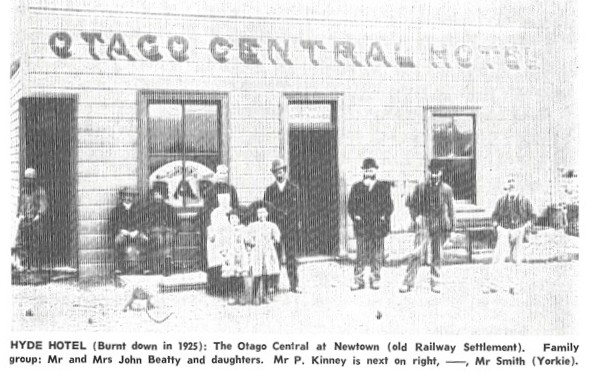 Photo: Otago Central Hotel, Hyde, early 1920s. Source: Hyde School Centennial booklet, 1869-1969, produced by the Hyde School Centennial Research Committee.
We left Hyde Hotel at the end of 1923 and funnily enough in August 1925 the Hyde Hotel was burnt to the ground: "Lane's Central Otago Hotel at Hyde and a store and hall attached were burnt to the ground yesterday morning." [Otago Daily Times, Issue 19568, 26 August 1925, Page 6] Some years later Raymond and I went to a trip through Central Otago, and stopped where the hotel was but there was no trace of it, nor the town hall which was next to the hotel. They had big functions, balls, and dances at the town hall. Quite often mum and Dad would get dressed up and go to the ball at the town hall. They enjoyed the interlude of social occasions like this.
This event was recorded in the newspapers of the time: "HOTEL BURNED. Auckland Star, Volume LVI, Issue 200, 25 August 1925, Page 9: WITH STORE AND HALL. DUNEDIN. This day. The Otago Central Hotel, with store and hall attached, an old landmark at Hyde, was destroyed by fire this morning."
1923-1925 Alexandra
Eileen recalls that at the end of 1923 the family moved from Hyde to Alexandra. An article in the Otago Daily Times, on 30 January 1924, records their leaving: "There was a big gathering of residents in the Hyde Hall on Wednesday last to bid farewell to Mr and Mrs J. B. Sharp (late proprietors of the Otago Central Hotel). Mr Sharp has sold his business, and intends to reside in Alexandra, where he has purchased another business. Dancing and songs were indulged in during the evening, those contributing selections being Mr Lockwood and Mr Shepard. Mr George Currie, on behalf of the residents of the district, presented Mr Sharp with an engraved gold-mounted walking-stick, and Mrs Sharp with an afternoon tea service as a token of the esteem in which they were held, Mr Thomas Dowling also made appreciative reference to Mr Sharp's qualities as a host and to the way in which Mrs Sharp had carried out her duties as postmistress". [Otago Daily Times, Issue 19082, 30 January 1924, Page 4]. John then sought to transfer the licence to a William Thomas Matthews [Otago Daily Times, Issue 19162, 3 May 1924, Page 13].
"I don't know how it came about but apparently the Caledonian Hotel in Alexandra was up for lease and father signed up. During these gaps between moving to one place to another, a few months here or there, Joan and Doreen and I usually ended up with either Grandma Healy or Mrs Strode, we called her Aunty Strode. We shared our holidays with them when we were on the move. Aunty Strode remained a family friend until her death in the late 1930s. She had one daughter named Mary who at 13 died of tuberculosis. They were also farmers who had a herd of cattle which she milked and sold the cream and milk. It made Joan and Doreen and myself more important to her as she liked our company, but she had 5 sons also, and one of her sons married Mabel Hughes.
At Alexandra, it was quite a nice hotel, partly wood, and brick, so Dad apparently got the lease of the hotel for three years. In those days the hotels were owned by widows or families and hotelkeepers paid a lease for so many years, it was usually three to five years.
Eileen says it was a nice place; Alexandra is a town quite different to Hyde, it was a big commercial farming area, with gold dredging in the Clutha. We enjoyed the different atmosphere compared to Hyde, which was quite unique and quiet, but Alexandra had a bigger shopping area, and businessmen, two or three banks, huge post office, doctors and dentists. It was surrounded by huge rocks and trees and surrounded by rivers, very warm, a good fruit growing place, and was the centre of the area's business.
John was a witness in a court case involving the theft of 197 rabbit skins by Robert John Gibson. The case was dismissed through lack of evidence. [Dunstan Times, Issue 3232, 11 August 1924, Page 5].
While we were living at the Caledonian Hotel, electricity was switched on one night with great joy and celebrations, and some of the engineers and electricians who helped put the electricity through were contracted to live at the hotel. Before that there were just the ordinary iron street lamps which were lit just before dusk.
"Electric Light. Alexandra has now its full benefit of the change. Most of the dwellings are now wired up, and those that are not will rapidly be done within a very short space of time. The Alexandra Herald's last issue displayed at the head of its For Sale columns this rather significant notice, 'For sale, kerosene lamps. Apply any householder, Alexandra.' And therein is the whole position in a nutshell. The whole of the conversation of everybody and anybody is impregnated with electricity. The ladies over their cups of afternoon toa discuss electric irons, kettles, toasters, radiators, electric scrubbing brushes, mops, dusters, and washing machines, while the man on the street discusses learnedly on watts, kilowatts, whatnots, ohms, amperes, volts, high tension, low tension, and all other contentions connected with the whole concern. The streets are not yet fitted up with electric lights, but that will follow in due course. It is the intention of the residents to make a gala day when the electric light is officially switched on, but owing to restrictions imposed by the Health Department, because of the outbreak of the infantile paralysis epidemic, it has been deemed advisable to postpone the function until after the restrictions are raised." [Otago Witness, Issue 3707, 31 March 1925, Page 31] See a longer article about the official opening ceremony in the Otago Daily Times, Issue 19467, 30 April 1925, page 2.
We left Alexandra in the spring of 1925. The publican's licence application transfer to Robert Kirk was approved. Wakatipu Licensing Committee. The following transfers were granted: Caledonian Hotel, Alexandra, J.B. Sharp, to R. Kirk. [Southland Times, Issue 19653, 11 September 1925, Page 10].
1925-1928 Dunedin
The family were back living in Dunedin between 1925 and 1928, with the children attending local schools.
1926-1935 Commercial Hotel, Green Island
John applied for the publican's licence of the Commercial Hotel in Green Island on 3 May 1926.
THE LICENSING ACT, 1908. LICENSING DISTRICT OF DUNEDIN SOUTH. NOTICE OF APPLICATION FOR A PUBLICAN'S LICENSE. I, JOHN BENTLY SHARP, of Green Island, Hotelkeeper, Do Hereby Give Notice that I desire to obtain, and will, at the next Licensing Meeting to be holden at the Town Hall, King Edward street, South Dunedin, on the 2nd day of JUNE, 1926, Apply for a Certificate authorising the Issue of a Publican's License for a House situate at Green Island, and known by the name of the Commercial Hotel, containing nine rooms, exclusive of those required for the use of the family. Dated the 3rd day of May, 1926. (Signature) J. B. SHARP, Moore, Moore, and Nichol, Solicitors for Applicant. [Otago Daily Times, Issue 19783, 7 May 1926, Page 12].
On 2 December 1926, the twins John and Desmond were born. "SHARP. On December 2, at "La Rochelle" (Nurse Ross's), to Mr and Mrs J. B. Sharp, Commercial Hotel, Green Island - twin sons." Eileen recalls that "Father bought a car when the twins were born because he realised he would have to have some means of getting around with a family, as he enjoyed going out on Sundays for picnics, so he bought an American Dodge, it was a huge car, it would take the four children on the back seat, and loaded with two extras as well when we went on these Sunday excursions into the country. We'd take enough food for two or three meals, sliced cold meat, salads, cake and a thermos to boil for the billy. During that time Tane was courting Joan and he would come out and stay at the hotel on Friday and Saturday night and away we'd go on Sundays when the older men would go and shoot rabbits. Other young men Tane knew would come out on the Sunday as well."
On 20 July 1927, Margaret advertised for help caring for the twins: Wanted, capable middle-aged woman, to care two babies; must be clean and careful. Mrs Sharp, Commercial Hotel, Green Island. [Otago Daily Times, Issue 20155, 20 July 1927, Page 11]
Eileen says: "Mother had also come into a small inheritance from the estate of her mother Margaret Healy (unverified as M Healy's will does not specify this - DH), and I think she put that money into the education of her daughters at Archerfield College, and there was the case of outfitting of the girls with uniforms in 1928, Joan and Eileen started in the February of 1928."

Sometime in 1928, John and Margaret, together with their six children, took up the lease at the Commercial Hotel at Green Island. At this stage, Eileen was 15 years of age, Joan 14, Doreen 12, Denis 10 and the twins Desmond and John were two. Desmond's earliest recollection of his childhood is of being dressed beside a gas heater by my mother or nanny on a morning in the smoking room of the hotel.


UNLICENSED RADIO SET. John Bentley Sharp, was charged with failing to take out a radio license.Chief Detective Cameron stated that the defendant had been in possession of the radio set for six or seven weeks without taking out a license. Fined 20s and costs. [Otago Daily Times, Issue 20840, 5 October 1929, Page 23]
From 1929 on, life continued much the same at the hotel, comings and goings, daily life, daily routine, we didn't have very many guests, just from time to time we had friends around. In 1931, mother was pregnant again and on 30 June, the youngest Norwood Alexander Sharp was born, weighing about 6 and a half pounds, a healthy boy, with fair hair and blue eyes. Now we are a family of seven, and later we had a nursemaid to help.
A MONTH'S IMPRISONMENT. Richard Joseph Keogh, for whom Mr B. S. Irwin appeared, pleaded not guilty to having stolen seven forks, two table knives, a toast rack, and three bottles of sauce, the property of John Bentley Sharp, licensee of the Commercial Hotel at Green Island. Chief Detective Young said that the accused was arrested on the evening of March 17 on a charge of being drunk while in charge of a motor car. He was in the company of a man named Pledger, and in the rear of the car were found the articles mentioned in the charge, which were subsequently identified by the complainant as his property. The complainant said that he recollected two men coming to his hotel late one afternoon about a month, previously. One of them, whom he did not know, went out of the bar for a time and returned. Witness went on to say that he had never made any statement regarding the stolen articles, whereupon Chief Detective Young requested permission to treat him as hostile. Joan Sharp, daughter of the previous witness, said she remembered having about March 17 last found a man in the dining room who said he was looking for a drink. Witness directed him to the bar, and on her return to the dining room later she discovered the loss of the articles mentioned in the charge. She could identify the knives and forks and toast rack produced as her father's property. Constable Le Sueur stated that when he interviewed the accused the latter denied that he had been in the complainant's hotel on the date in question. The accused, in evidence, stated that on March 17 he was so far under the influence of liquor that he did not recollect clearly what he had been doing. The magistrate refused to believe the accused's story, and stated that he had either stolen the goods or was an accessory with Pledger in the theft. He would be sentenced to a month's imprisonment. [Otago Daily Times, Issue 21952, 13 May 1933, Page 22]
We'd also go on fishing trips out to Outram Glen and the Clutha and sometimes up north to a place called Waitati, and go inland there to the Waitati Steam or river, and to the fisheries where they were cultivating and experimenting with trout which were later released into the rivers in the Otago area.
We also had many trips to the beach for swimming, and we had lots of picnics, it was great relaxation for father. Father also found relaxation going off with two or three of his men friends - they would go off fishing way down the harbour fishing for blue cod.
We always had plenty of food and always seemed to be something going on, someone wanting food, it was a very enjoyable life at Green Island, and the boys joined in everything, and Joan, Doreen and I were making friends locally, and with Tane, there was a group of young men around, and we had church dances at the Church of England once a month during the winter from Easter to Labour Day. We congregated together as a group at these dances, also the tennis club dances. Then there were balls which came and went, the brass band ball, the football club ball, and they were held in the big town hall next to the hotel, and there were bus loads of people who would come out from Dunedin, it was a novelty coming out in the bus to the country balls.

Over the next two to three years Norrie grew to be a difficult boy and mother decided to put him into an academy with the sisters to teach him to settle down because in a year or so he would be entering school, but he remained there until he was older, then moved to other schools as mother and father moved around.
Break from hotel life
Desmond recalls that his parents retired from hotel life in 1936, and bought a house in London Street, Dunedin. They had decided they wanted to get out of the hotel, even though the lease had been for 10 years, and as it was a family trust hotel, and they had been unable to purchase it. John advertised the publican's licence for transfer to Francis Edward Denys Davy on 10 November 1936 [Otago Daily Times, Issue 23034, 10 November 1936, Page 11].
According to newspaper advertisements, in 1938, John sought to sell the London Street property and subdivide. The entire house at 75 London Street was to be dismantled and the house demolished to make way for new sections to erect four modern houses. The removal of the 66 year old house was lamented in the local newspaper as a loss of history of the city and its original owner Mr John Logan. [Otago Daily Times, Issue 23383, 24 December 1937, Page 22] [Evening Star, Issue 22865, 25 January 1938, Page 2] [Evening Star, Issue 22910, 18 March 1938, Page 2] [Otago Daily Times, Issue 23463, 30 March 1938, Page 18] [Otago Daily Times, Issue 23511, 27 May 1938, Page 15] [Otago Daily Times, Issue 23512, 28 May 1938, Page 32] [Evening Star, Issue 22976, 6 June 1938, Page 2] [Otago Daily Times, Issue 23901, 31 August 1939, Page 18].
The family moved to 10 Wilson Avenue, St Clair, Dunedin, into a modern new home about 1937. By chance John and Margaret had a week or ten days holiday in Christchurch at the big race meeting, and while they were there they approached friends of theirs, the Gregorys, and they ran a restaurant in the centre of town. It was a big place, upstairs was a huge kitchen, and a ballroom, and a smaller room with its own smaller kitchen, a conference room, and they held dances upstairs regularly. It was a leading place for social life in Christchurch. After living privately for the past few years, John and Margaret arranged to manage the business in Christchurch, and once again the family was on the move. "My father took on the management of the White Hart Hotel, in High Street, Christchurch. My parents rented a house in Bealey Avenue where we lived for a short time. Then my parents decided to run the Trafalgar Hotel in Nelson as proprietors, so in October 1941 we all shifted to Nelson." "AUCTIONS. N. H. McCROSTIE AND CO. IMPORTANT AUCTION SALE. NEARLY NEW MODERN OAK FURNITURE AND EFFECTS. THIS DAY. AT 1 pm On the Premises, No. 69 LONDON STREET RICHMOND. On account of MR J. B. SHARP. Nearly new upright grand PIANO BY BREMAR, BEAUTIFUL 3-PIECE LOUNGE SUITE IN CRUSHED VELVET, AXMINSTER (ONLY 5 MONTHS OLD). LATE MODEL ELECTROLUX, COMBINATION COCKTAIL AND CHINA CABINET IN OAK, TWIN BEDROOM SUITE, WATER COLOURS, LOVELY CRYSTAL, VASES, BRONZE FIGURE. FRAMELESS MIRROR TALLBOY, LAWNMOWER, GARDEN TOOLS, ETC. EVERYTHING FOR SALE. NO RESERVE. ON VIEW FROM 9 A.M. N. H. McCROSTIE and CO. Auctioneers, 217 Manchester street. Phone 34-459." [Press, Volume LXXVII, Issue 23465, 21 October 1941, Page 12] (Nelson)
#/media/File:High_Street,_Christchurch,_1940s.jpg)
Trafalgar and Royal Hotels, Nelson
In October 1941 John and Margaret took up the lease of the Trafalgar Hotel in Nelson, and the family moved up there. You can read more on Desmond's page. Apparently there was an incident where a chimney caught fire and he was later fined 5s. "THANKS. MR and MRS J. B. SHARP. Trafalgar Hotel, wish to extend their sincere thanks to the Nelson Fire Brigade. Police, the public and members of their Staff, and to Mr and Mrs R. D. Sutherland for their kindness and courtesy extended to them during the recent fire, especially for the good work done by the Fire Brigade". [Nelson Evening Mail, Volume 76, 8 December 1941, Page 2].
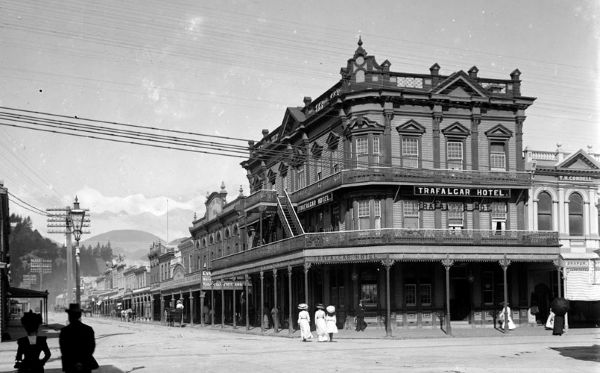
Photo: Trafalgar Hotel, 1940s. Source: Facebook: New Zealand Pubs Past and Present. Trafalgar Hotel, Nelson, built 1908, demolished 1966. Frederick George Radcliffe photo.
John later applied for a publican's licence advertised in the Nelson Evening Mail on 4 May 1942. The hotel was in the main street of Nelson, a three storey wooden building with accommodation for guests a bar and dining room, kitchen etc, and the family lived on the premises. The hotel was transfered to Reginald Thomas Best as advertised on 30 March 1944 in the Nelson Evening Mail. [Nelson Evening Mail, Volume 79, 30 March 1944, Page 1].
However, just before that date, the Trafalgar Hotel had been in the subject of another fire where Margaret was injured. "An outbreak of fire at the Trafalgar Hotel was attended by the Nelson Fire Brigade at about 10.20 o'clock last night. When the brigade arrived flames and smoke could be seen issuing from the roof at the rear of the building, but the fire was under control within ten minutes and the damage was confined to the roof, rafters and ceiling of one block comprising about a third of the building. The cause of the fire is attributed to a spark lodging under the eaves of the building following a chimney explosion which occurred at 5 o'clock in the afternoon. The kitchen fire had been banked up for the afternoon and when Mrs J. B. Sharp, the wife of the proprietor later poked the fire it exploded violently and she received severe burns on her hands and one arm, necessitating medical attention. The brigade's two engines attended the fire, and 200 feet of delivery hose were used, in addition to bucket pumps. Apart from structural damage to rafters and roof, the repair of which will probably cost several hundred pounds, the effect on the hotel and contents was confined to a small area of ceiling burnt and scorched, a portion of the linoleum floor covering which had to be removed and the wallpapers on the ceilings of some of the upper floor rooms which were stained with water and smoke. Guests in the hotel hurriedly evacuated their rooms when the alarm was given and clambered down the fire escapes or ran down the stairs, many of them in their night attire and carrying suitcases, bundles of possessions or drawers full of clothes. Many people were returning home from the pictures at the time the alarm was given and a large crowd of spectators gathered to watch the brigade go into action. The Trafalgar Hotel building is owned by Mr Thomas MacGillivray, of Waimea road, Nelson, and is insured with the Alliance Assurance Company. The contents are insured with the London and Lancashire Insurance Company. The Trafalgar Hotel experienced a previous fire on the 4th December 1941, when the roof and part of the upper floor was considerably damaged." [TRAFALGAR HOTEL FIRE. Nelson Evening Mail, Volume 79, 1 February 1944, Page 4].
DONATION TO FIRE BRIGADE. The owner of the Trafalgar Hotel, Mr Thomas MacGillivray, has forwarded £1O to the Nelson Fire Brigade as a mark of appreciation of its services rendered at the recent fire at the hotel. He asks that the donation be applied to the Brigade Members' Fund. [Nelson Evening Mail, Volume 79, 8 February 1944, Page 3].
After they left the Trafalgar Hotel in March 1944, it appears they managed the Masonic Hotel in Nelson for a number of months, before applying for a publican's licence for the Royal Hotel, at the corner of Collingwood St. and Bridge St, Nelson, containing 34 rooms, exclusive of those required for use of the family. [Nelson Evening Mail, Volume 80, 27 April 1945, Page 2].
When they left the Royal Hotel is unknown as newspapers of the time are not yet digitised, but they then retired. Eileen says: "I feel the success of their 40 years in hotel life was due to their team work."

Many newspaper clippings of John Bentley Sharp are recorded in a separate file for downloading - John Bentley Sharp - Newspaper Clippings.
Unfortunately in 1949 John and Margaret split up, going their separate ways. By this time, all their children had grown up and left home. John went back to Dunedin and lived with his daughter Doreen and her family. She looked after him for a long time until he used to wander off and not know where he was. Eventually he went to Cherry Farm for his own safety where he had 24/7 care until he died in 1964. Margaret also returned to Dunedin and lived separately.
More photos of John Bentley Sharp can be found in the Photo Gallery.
Death
John Bentley Sharp died at Cherry Farm Hospital on 26 June 1964 aged 79 years resident of 37 Greenhill Avenue, Dunedin. He was buried on 27 June in Block 251, Plot 49, at Andersons Bay Cemetery. When Margaret died 16 years later in 1980, she was also buried in this plot.
His Death Notice reads:
"Sharp, on June 26, 1964, at Dunedin, John Bently (Jack), husband of Margaret Sharp, loved father of Eileen (Mrs E Baker, Pine Hill), Joan (Mrs J L T Braithwaite, Mornington), Doreen (Mrs D Morrison, Wakari), Dennis (Sydney), John (Motueka), Desmond (Wellington), and Norrie (Dannevirke), and loved grandfather of all his grandchildren, aged 79 years. The funeral will leave our chapel, 78 St Andrew St, today (Saturday) June 27 after a service commencing at 1 pm for the Andersons Bay Cemetery. Messages to 32 Elgin Road, Mornington. No flowers by request. Hope and Sons Ltd, funeral directors."
 Headstone - John Bentley and Margaret Sharp |
 Desmond Sharp and his family at the grave of John Bentley Sharp in January 1976. |
The headstone inscription reads: In Loving memory of John Bently Sharp, died 26th June 1964, aged 78 years, and his beloved wife Margaret, died 28 September 1980, aged 93 years.
More details about the life and times of John Bentley Sharp are told by his son Desmond.

Dale Hartle at Sharp Family Plot, December 2019.