Sharp-Healy Family
The Story of the first two Generations
Links:
Generation 2 - Children of John Bentley Sharp
Denis John Thomas Sharp, 1918-2004
Beyond the Chindwin
Beyond the Chindwin - The story of one of the columns that penetrated over a thousand miles into Japanese-held territory in February of 1943, told by its commander - Bernard Fergusson, later to become Governor-General of New Zealand.
Early in the book, Fergusson was describing three new officers who had joined his camp in Narain where he was training his troops for the forthcoming march into the jungle.
Page 31: "Denny Sharp was a Flight-Lieutenant in the Royal Air Force. A native of Dunedin, his father kept a hotel in Nelson, New Zealand; and Denny had come home to join the Air Force just before the war. In manner he was on first acquaintance rather casual and morose, and took a bit of melting; he too had a caustic tongue, and often after listening in silence to our arguments he would throw in two or three blistering words which made everybody laugh, and lose the thread of the talk. He had fought in fighters in Singapore, and had had an exciting escape by way of Sumatra."
Later on he describes this encounter with a Japanese plane. Page 122: "At four o'clock in the afternoon, we were just crossing some paddy when a Jap aircraft came over us at about a thousand feet. It was a chance we had taken fifty times without being seen, but this time we were caught well and truly in the open. The aircraft circled us twice; one could imagine the little, malevolent yellow face of the pilot, staring down through his goggles and counting us as he banked; and then it flew off southward, while Denny Sharp growled, "If I'd been him, and that had been a Hurricane, and he'd been down here ..."
And an incident in the jungle. Page 123: "The morning of the seventeenth was again a fearful march, with a blazing sun and no shade. At a halt, Denny Sharp pinched the slender tree I had in mind for my own shade: I remember and am still ashamed of the way in which I told him to go and find another."
References to Denis are dotted all through the book, where Fergusson quotes his encounters with the Japanese, and giving orders to his men. Denis, or Denny as he is affectionately known by Fergusson, was responsible for finding drop zones for supplies, organising pick-up points, looking after animals (horses and mules), and reconnaissance. The story tells of the struggles of the troops through thick jungle, crossing treacherous rivers, and wading through swamps as they raced and chased the Japanese. Often, encounters with the enemy resulted in the loss of life, including animals, and the loss of supplies. The book is out of print now, but can be ordered from the Collectibles or Amazon websites. It also has photographs and maps.
In the Epilogue to the book, Fergusson says that among others, Denny Sharp was "mentioned in despatches" for their bravery.
Fergusson also asks: "What did we accomplish? Not much that was tangible. What there was became distorted in the glare of publicity soon after our return. We blew up bits of a railway, which did not take long to repair; we gathered some useful intelligence; we distracted the Japanese from some minor operations, and possibly from some bigger ones; we killed a few hundreds of an enemy which numbers eighty millions; we proved that it was feasible to maintain a force by supply dropping alone. But we amassed experience ... a wealth of knowledge which has since been put to good account."
450 fighter sorties
The following is an extract from a book published online called the "New Zealanders with the Royal Air Force (Volume III) - CHAPTER 15 - Operation thursday and the Victory at Imphal" found on the New Zealand Electronic Text website.
Nearly one hundred New Zealand fighter pilots flew and fought with the RAF Spitfire, Hurricane and Beaufighter squadrons through these hard months of the 1944 Burma campaign. The records show that in their various missions over difficult country, and often in treacherous monsoon weather, many of them displayed efficiency keenness and courage of a high order; there are also references to the 'determination, skill and fine offensive spirit' shown by individual pilots, to their 'splendid support for the Army' and to 'distinguished leadership' on the part of squadron and flight commanders.
Squadron Leader Bruce Ingram and Squadron Leader Denis Sharp did particularly good work as fighter leaders. ... Denis Sharp led a squadron of ground-attack Hurricanes which scored impressive results against enemy troops, transports and communications, especially during the Japanese retreat from Manipur. Sharp himself successfully attacked enemy railway engines on two occasions while operating by night over 150 miles inside enemy territory. By mid-1944 he had completed a total of 450 fighter sorties, which included operations over Britain, Singapore and Ceylon as well as Burma. 'Under his leadership,' writes a senior officer, 'No. 11 Squadron has built up a great reputation in low attack work with a long record of successes achieved by night as well as by day and in the face of the many difficulties of terrain and weather constantly to be met in this theatre.'
First Chindit expedition
An extract from Wikipedia on the Burma Campaign gives some background. The photo is from the archive at the Imperial War Museum, London (supplied by Stephen Fogden of England).
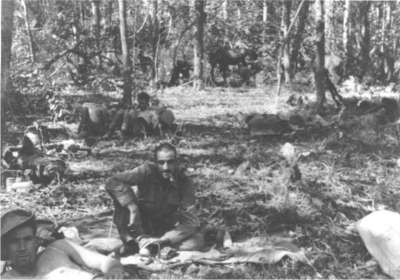
The second action was much more controversial; that of the 77th Indian Infantry Brigade, better known as the Chindits. Under the command of Major General Orde Wingate, the Chindits marched deep behind enemy lines with an initial aim of cutting the main north-south railway in Burma. The operation had originally been conceived as part of a much larger coordinated offensive, which had to be aborted due to lack of supplies and shipping. Almost all of the original reasons for mounting the Chindit operation were then invalid. Nevertheless, it was mounted anyway.
Some 3,000 men entered Burma in many columns. They did cause damage to the communications of the Japanese in northern Burma cutting the railway for possibly two weeks. However, they suffered heavy casualties; 818 killed, wounded or missing, 27 percent of the original force. Those that did return were wracked with disease and quite often in dreadful physical condition. Though the operational results can be questioned, the Chindits proved that British and Indian soldiers could live, move and fight as effectively as the Japanese in the jungle, and this aspect of the campaign was used to great propaganda effect, countering the impression created after the battles of early 1942 that the Japanese could not be beaten in the jungle. It was also said by the Japanese commanders after the war that the Japanese in Burma decided to take the offensive, rather than adopt a purely defensive stance, as a direct result of the Chindit operation.
Each column was typically composed of about 400 men built around an infantry company plus reconnaissance platoon of the Burma Rifles, two mortars and two Vickers machine guns, mule transport platoon (about 120 mules), an RAF liaison officer and radio operators to direct air supplies, a doctor, and a radio detachment to provide communications between columns.
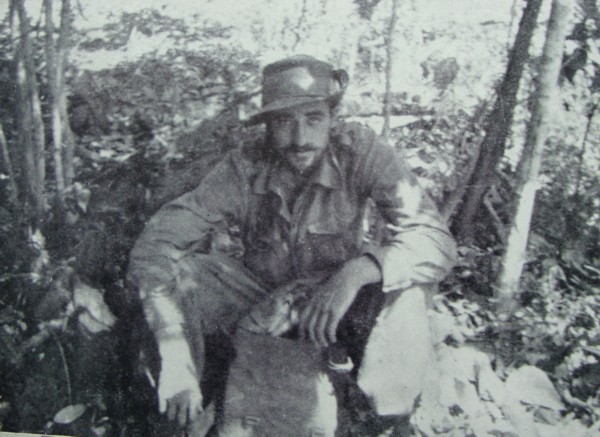
Caption: This photo of Denis Sharp is taken from the 1945 edition of 'Beyond the Chindwin', page 217, supplied by Stephen Fogden of England.
Air supply was provided by a detachment from 31 Squadron RAF and operated from Agartala in eastern Bengal. It varied in size during the expedition but seldom exceeded three Hudson and three DC3 aircrafts. Fighter escorts were provided when the range permitted but were not available when emergency drops had to be made at short notice. No aircraft was lost during the operation. The Chindits selected the drop zones when and where required. Initially it was thought that airdrops would only succeed in open clearings but by chance an emergency airdrop had to be made in jungle terrain, this proved successful and this method was to be used again. Even though the airdrops themselves were successful, the difficulty of the operation meant that on average each man only received half of the rations they required.
View a map of the Chindit operation. The Chindits website also has newspaper coverage of the operations.
The following is an extract from a book published online called the "New Zealanders with the Royal Air Force (Volume III) - CHAPTER 15 — Operation thursday and the Victory at Imphal" found on the New Zealand Electronic Text website: Ref: NZ Electronic Text Website
Denis Sharp led a squadron of ground-attack Hurricanes which scored impressive results against enemy troops, transports and communications, especially during the Japanese retreat from Manipur. Sharp himself successfully attacked enemy railway engines on two occasions while operating by night over 150 miles inside enemy territory. By mid-1944 he had completed a total of 450 fighter sorties, which included operations over Britain, Singapore and Ceylon as well as Burma. "Under his leadership," writes a senior officer, "No. 11 Squadron has built up a great reputation in low attack work with a long record of successes achieved by night as well as by day and in the face of the many difficulties of terrain and weather constantly to be met in this theatre."
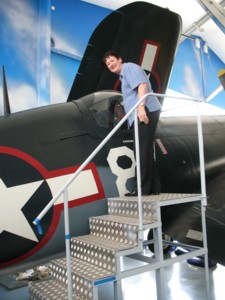
The Corsair Fighter Jet
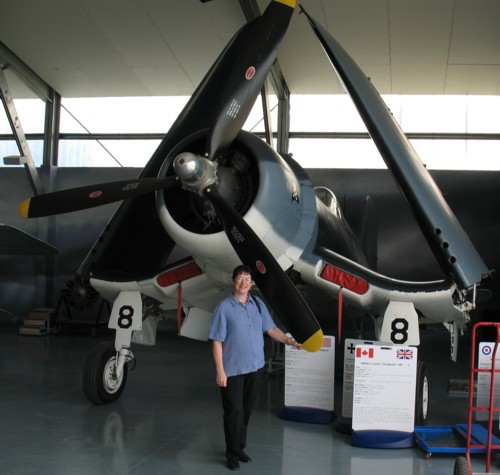
Denis flew Corsairs and trained pilots on them at the end of World War II. The Hood Aerodrome in Masterton has one of the last remaining flying Corsairs, named "Josephine" as one of the exhibits. In November 2008 Dale Hartle visited the Vintage Aviator Fighter Collection museum and photographed the Corsair.
The Corsair was a successful aircraft which was in use for 20 years, operating in the Korean War before being retired from service in 1965. It has a distinctive inverted gull wing, and the wings fold up for use on aircraft carriers.
Twelve and a half thousand Corsairs were produced, serving with the US Navy, US Marines, Royal Navy Fleet Air Arm and the RNZAF. The Allies called this aircraft the 'bent winged bird', the Japanese named it 'whistling death'. 424 Corsairs served in the Pacific Theatre with the RNZAF. The plane on exhibition was been rebuilt over the past 20 years, and is regularly seen at air shows around New Zealand. It is owned and operated by The Old Stick and Rudder Company based at the Hood Aerodrome in Masterton. You can see a video of the Corsair in flight during Wings over Wairarapa on YouTube. There's photos of the Corsair in flight on Flickr - photo one, photo two, photo three.
References
Fergusson, Bernard, "Beyond the Chindwin, Being an Account of the Adventures of Number Five Column of the Wingate Expedition into Burma, 1943". First published in original edition 1945, this edition 1962. Printed in Great Britain, Collins Clear-Type Press: London and Glasgow. Copy held by Desmond Sharp. Brigadier Fergusson has written a military classic which by its humour, compassion and essential nobility makes obligatory reading for anyone wanting to know how ordinary British soldiers lived, fought and died under extraordinary conditions
Other books featuring the exploits of Squadron Leader Denis Sharp, Distinguished Flying Cross mentioned in dispatches 1939-1945:
- Escape from Singapore, by Fred Thurlby and Bill Maxwell
- Burma Surgeon, by Gordon S Seagrave. Publisher W W Norton & Co (1 Jan 1943). This wartime book details Doctor Gordon S. Seagrave's fight against malaria, dysentery, plague, and other diseases in the Far East.
- Battle for Palembang, by Terence Kelly. Publisher Robert Hale Ltd; First Edition (19 Sep 1985). Refer to Wikipedia for a description of this battle.
- Hurricane and Spitfire Pilots at War, by Terence Kelly. Publisher Arrow Books Ltd; New edition edition (15 Sep 1988). A collection of memories and views on the merits of the Hurricane and Spitfire fighter aircraft, by some of the pilots who flew them in Britain, the Middle East and the Far East in World War II. The author was himself a Hurricane pilot.
- Fight for the Sky: The Story of the Spitfire and Hurricane by Douglas Bader. Publisher Pen & Sword Books Ltd; Revised edition edition (May 2006). Pen and Sword Books have reissued this book that the legendary 'legless' ace Douglas Bader (immortalised by the film Reach For The Sky) wrote. He tells the inspiring story of the Battle of Britain from the viewpoint of 'The Few'. Using superb illustrations he traces the development of the Spitfire and Hurricane and describes the nail-biting actions of those who flew them against far superior numbers of enemy aircraft. As an added bonus, other well-known fighter aces including Johnnie Johnson, 'Laddie' Lucas and Max Aikten contribute to Douglas's book, no doubt out of affection and respect. This is a really important contribution to RAF history by one of the greatest -and certainly the most famous - pilot of the Second World War.
- Hurricane Over the Jungle: 120 Days Fighting the Japanese Onslaught in 1942, by Terence Kelly. Publisher Leo Cooper Ltd; New edition (Mar 2005)
- Hurricanes Over Singapore: RAF, RNZAF and NEI Fighters in Action Against the Japanese Over the Island and the Netherlands East Indies, 1942, by Paul Sauntenhaag. Publisher Grub Street; illustrated edition edition (August 2004). Hurricanes over Singapore is the companion volume to the successful Buffaloes over Singapore published in 2003. It continues the story of the RAF's gallant but futile attempt to stop the might of the Japanese invasion force in its quest to conquer not only Singapore, but also Sumatra and Java and all the other islands that constituted the Netherlands East Indies. The Hurricanes went into action over Singapore on 20 January 1942 and the last two aircraft made the final flight at Java on 8 March that year. During the intervening time the Hurricane pilots and ground crew - British, New Zealanders, Australians, Canadians, Dutch and Americans - gave their all, with many making the supreme sacrifice. The majority of survivors would spend the next 3½ years as prisoners of the Japanese - and some of their heart-rending stories are detailed here.
- The Air Battle for Imphal, by Norman Franks. Publisher William Kimber & Co Ltd; First edition (June 10, 1985). Refer to Wikipedia for more information about this battle.
- Those other eagles, by Christopher Shores. (Those Other Eagles: A Tribute To The British, Commonwealth And Free European Fighter Pilots Who Claimed Between Two And Four Victories In Aerial Combat, 1939 - 1982)
- Bloody Shambles, by Christopher Shores and Brian Cull. Bloody Shambles, Vol. 1 , pub 1992. This is the story of the Allied air campaign across Singapore, Malaya, Burma, Ceylon and the Philippines during World War II. It documents the Allied underestimation of Japanese ability, which led to the destruction of 50% of the British bomber force in two days. Bloody Shambles: From the Defence of Sumatra to the Fall of Burma, Vol. 2 by Christopher Shores, Yashuo Izawa, Brian Cull pub Feb 2009. This is the story of the Allied air campaign across Australia, Sumatra, Java, the Philippines, Burma and Ceylon during World War II. It documents the Allied underestimation of Japanese ability, and ends with the Japanese at the extremities of their advance.
- Biggin on the Bump: The Most Famous Fighter Station in the World (Paperback), by Bob Ogley. Froglets Publications Ltd (24 May 1990). This is the story of the most famous fighter station in the world - an airfield inhabited by the shadows of extraordinary men and women. Bob Ogley brings it to life and, from the first page, gives a fascinating insight into the men, the women, the machines and the indomitable spirit of those drawn into conflict from 1916 to 1945 and beyond.
- Wingate Adventure - Behind the Japanese Lines in Burma - an account of the most amazing military experiment in World War 2 (Hardcover), by W G Burchett. Publisher F. W. Cheshire Pty Ltd (1 Jan 1944)
- Hurricane at War, by Charles Bowyer. Publisher Ian Allan Ltd; 1st edition (14 Jan 1974)
- Return via Rangoon, by Phillip Stibbe. Publisher Newman Wolsey (1 Jan 1947)
- Last Flight from Singapore, by Arthur Gerald Donahue. Publisher Kessinger Publishing (Mar 2007)
- Out of the Blue: Pilot with the Chindits, by Terence O'Brien. Publisher Arrow Books Ltd; New edition edition (17 Nov 1988). Terence O'Brien, a young Australian, survived a full tour of bombing missions with Coastal Command before volunteering to join the Chindits. This is a memoir of his days with the 4/9th Gurkhas in the remote mountainous region between northern Burma and Yannan.
Return to Denis Sharp - main story.