Sharp-Healy Family
The Story of the first two Generations
Links:
Generation 1
Margaret Gallagher 1855-1926
Margaret Gallagher was one of twin girls born in Londonderry, County Donegal, Ireland around 1855. She was christened Margaret Helferte (or Marguerite Helfete according to Beverley). Her father was Dennis Gallagher and her mother was Jane Duggan.
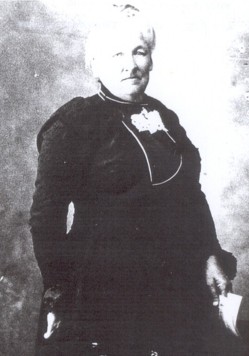
Some believe her father was a Frenchman. How he happened to be in Ireland is unknown, but he may have been a survivor of the French Armada of ships heading for Ireland to assist the Irish in their rebellion against the occupation by the English. As history relates, the armada was wrecked on the Irish coast about that time. However recent DNA results from a member of the family show no sign of French blood, but a hint of Norwegian. The mystery continues.
Possibly Margaret was illegitimate, otherwise why would she have been separated from her twin sister at birth and immediately adopted out to different families. By adoption she became Margaret Gallagher.
Research has found that her death certificate states that Helferte was her mother's maiden name. In the National Library of Ireland in Dublin in April 1997, Desmond Sharp searched the microfilm for the County of Donegal for the years 1850-1865 for the baptism record of either Margaret Gallagher or Margaret Helferte. No record was found. In light of the unsettling times prevailing in Ireland at the time of her birth, this is not surprising. The only records available for Catholics are those kept by the Parish Priest of the day. They are handwritten and possibly incomplete. The name and descendants of Margaret's twin sister are unknown.
Journey to New Zealand
However we do know that Margaret aged about 16 years eventually set sail in an old sailing ship for the long journey to Otago in 1872 as nanny to the children of the Carey family. Descendants of the Carey family still live around Naseby in Central Otago (as told by Beverley in her memoirs in April 1995). We have not identified the ship she travelled on, and some records are sketchy, especially in relation to women travelling with families as nannies as they were not listed separately. Members of the Carey family are buried at the Swinburn Cemetery.
When the Carey children had outgrown the need for a nanny, it is believed that Margaret sought and obtained work at one of Naseby's hotels where she may have met Thomas Healy, and later married on 5 July 1881. Members of the Carey family are buried in the Swinburn Cemetery.
MARRIAGE. Healy, Gallagher. At Dunedin, on the 5th inst., by the Rev. Father Walsh, Thomas Healy, Manager East Kyeburn Station, to Margaret Gallagher of Naseby. [MOUNT IDA CHRONICLE, VOLUME XI, ISSUE 614, 7 JULY 1881]
Life on the Maniototo
Beverley quotes in her memoirs how Thomas and Margaret built their own cottage of river stones and mud at Kyeburn on the banks of Boundary Creek, gradually enlarging it to contain four small bedrooms and various farm sheds as the family increased in size over the years. The surrounding scenery where they established their farm is magnificent; a green valley surrounded by snowcapped mountains, close to the Kyeburn river, with a crystal clear trout stream running through the farm close to the cottage. This little stream provided the only source of water for the house and farm and the water had to be carried in cans to the kitchen when needed. Apart from general farming, Grandfather Healy indulged his love of horses and kept a number of race horses. He also opened and operated a small open cast coal mine in the nearby hills of Mt Pisgah.
See Google Map for location of original Healy homestead on Boundary Creek.
The cottage was small, very small for a large family, with only candles and kerosene lamps for lighting. There was no laundry, and the weekly wash was boiled in a cauldron over a wood fire outside, and in the winter time in freezing snow.
Remnants of the cottage and outbuildings still exist today. They are at a location known as Healy's Trees, accessible by 4-wheel drive on private property. A lot of the large trees growing there have destroyed or damaged the stone walls, or they are buried under the vegetation. See the Kyeburn page for more information and photos of a 2026 visit by Dale Hartle.
The children didn't start school until they were eight to ten years old as they had long distances to walk or ride a horse, and had two swift flowing rivers to cross over narrow bridges. In very bad weather and snow, they had to remain home.
Yet even in these primitive surroundings, these children were taught the finer points of living. Girls were encouraged to be ladylike and well-mannered, shoes must always be shined, linen starched, silver polished regularly, food attractively presented, and woe betide those who slipped up on table manners.
There were no shops for miles, so every three months, Grandfather Healy would travel by horse and cart on the long journey to Dunedin to buy supplies. As we know people in those days had very large families, and married women were constantly pregnant. There was little or no medical help, and many mothers and babies died. On one of Grandfather Healy's journeys away for supplies Margaret, all alone except for her first three little children, gave birth to Beverley's mother, Frances. She delivered the baby, cut the umbilical cord, washed and dressed it and then cooked breakfast for the other toddlers. There was no-one nearby to help her. Her pride in her achievement turned to fury with Grandfather when on his return a week or more later, he did not notice she was no longer pregnant and had had the baby! She had to tell him!
A newspaper article on 25 February 1892 states: At a sitting of the Court on Monday last (before Messrs. N. P. Hjorring and J. Lundon, J.P's.), Margaret Healey, of Kyeburn, was charged, on the information of Sergeant Green, with stealing from the shop of Mr. James Brown two pairs of boots, 18yds. of ribbon, and an apron, of the value of £1 6s. The offence was committed on Saturday night, and the accused was arrested on Monday morning when about to leave by the coach, the goods being found in her possession. Mr. S. E. McCarthy appeared on behalf of accused, and said he had been instructed to plead "Guilty". Mrs. Healey having been under the influence of liquor when she took the goods. Counsel pointed out to the Bench that the accused was the mother of a large family, and if she were imprisoned the cost of keeping the children would be thrown on the State. This was the first time she had ever appeared in Court on any charge, and if the case had been brought in a higher Court she would have received the advantage of the provisions of the Probation Act. He therefore held that the accused should be convicted and discharged. Mr. Hjorring said the Bench recognised the offence as being a very serious one, and could not see their way to dismiss the case. Taking all the circumstances into consideration, however, they were disposed to deal as leniently as possible, and would inflict a fine of 26s., the stolen property to be returned to Mr. Brown. The accused paid the fine. [Mount Ida Chronicle, Volume 23, Issue 1160, 25 February 1892, Page 3]
There is also a newspaper article about the annual Kyeburn school picnic, in which Margaret Healy is mentioned, along with other ladies, as having contributed to the organising of the catering for the picnic. [Otago Witness, Issue 2398, 15 February 1900, Page 38].
The children led simple, healthy country lives: their enjoyment - ice skating or curling on the frozen ponds and "tickling trout" in the streams to hand-catch some fish for dinner.
In 1913 in the twilight years of the horse and cart when the occasional motor car started appearing in Kyeburn, Grandfather Healy sold his freehold land which he had acquired in 1903 to a Mr A.B. Hore, but retained the leasehold property near the river Kyeburn, and it remained in the Healy family until 1928, two years after Margaret's death, when it was transferred to Mr W.D. Hore.
This table below lists the 10 Healy children, their birthdates, age at death, number of children, and where they died/are buried.

A Hard Case
Eileen says that Grandma Healy was a "hard case". She remembers her well, and stayed with her between the ages of 5 and 12.
Eileen says in a letter and Christmas Card dated 13 December 1982 to Norrie and Aileen that "Grandma Healy's house frontage has been preserved by the Historic Places Trust at Naseby," but this has yet to be confirmed.
However, life in the Healy household must have been very difficult at times, and it must have come to a head in mid-1914, when Margaret made the agonising decision to apply to the authorities to have four of her children who were still living at home - Patrick, Susan, Catherine and Francis - committed to an institution for their own well-being.
Mount Ida Chronicle NASEBY, FRIDAY, AUGUST 14th. The Magistrate, Mr E. W. Burton, and Constable Lemm visited Kyeburn on Wednesday to inquire into four cases of alleged mentally defective children, belonging to Thos. Healey, the ages ranging from 20 to 24 years. Arrangements were made to join the train at Kokonga the following day, en route for Seacliff, for further medical examination. [Mount Ida Chronicle, Volume XL, Issue XL, 14 August 1914, Page 2]
All four were in their early 20s, and all were diagnosed as being "an imbecile from birth". Patrick and Catherine had congenital hypothyroidism, with Francis being quite severely handicapped with cerebral palsy, and Susan suffering from physical deformities which labelled her a cretin. They were sent to Seacliff Mental Asylum on 14 August 1914, never to leave or return home, although Margaret did apply unsuccessfully to have the girls returned to her in 1920.
The reasons they were committed were clear: the four brothers and sisters were noted as being unable to care for themselves, and were often found wandering the hills in a half-dressed dirty state. Their parents Margaret and Thomas were noted as being drunken, or alcoholics according to the local Naseby constable and two certifying doctors.
Patrick, Susan and Catherine went on to live long lives at Seacliff, although Francis died in 1921. You can read their individual stories on their webpages to learn why they were sent away, what happened to them, and life in Seacliff.
On 26 April 1920, two years after her husband Thomas Healy died, Margaret Healy applied by letter to the Superintendent of Seacliff asking to have the girls released into her care:
Just a line to say I have been out to the mental hospital last week to see the girls, and I would like to have them home with me very much. I am now living on my own and miss them very much. I have the means of keeping and providing for them and they would be great company for me trusting you will give this your fullest consideration and let me know as soon as possible. I will be down in Dunedin early in June and hope everything will be fixed up by then ready for me to take them home with me. I can see no reason why they should not be home with me. Yours sincerely, Mrs M Healy.
However there is no reply on file, and from the records it is obvious that the girls did not return home to live with their mother. In fact they quite liked being at Seacliff, and were not interested in leaving. And from reading the files, the physical and mental condition of Patrick and Francis precluded their ever leaving Seacliff either.
This is the only letter from any member of the family on the files obtained from the Otago District Health Board Archives, except one from Rose in 1968 giving instructions on the eventual death of her brother Patrick, who was by then in his 70s, and she herself was 84 years.
It would appear that Margaret moved into Naseby after the children left the home, because there is a notice in the local newspaper from Thomas Healy stating the following: "My wife, Margaret Healy, having deserted her home, I will not be responsible for any debts contracted by her on and after this date. Thomas Healy." [Mount Ida Chronicle, Volume XLV, Issue XLV, 29 September 1916, Page 2]. A month later, there was her response: "In Justice to myself and family, I beg to state that my husband has sorely wronged me as I owe no debts nor never have, and what he calls a home is only a hovel, as everybody knows. Margaret Healy, Kyeburn." [Mount Ida Chronicle, Volume XLV, Issue XLV, 10 November 1916, Page 2]
Other References
Other references to the family are held by the Naseby Museum:
- May 1898 HEALY: Jane – home duties, Kyeburn, single, 16y, Roman Catholic, native of NZ. Treated for 'fainting spells', seven days cost 25 shillings. (Naseby Hospital Admissions Book)
- Healy, Margaret, 44 yrs, admitted 11 Feb 1900, b. Ireland (c. 1856) R.C. 28 yrs NZ.
- February 1901 HEALY: Margaret – home duties, Kyeburn, 44y, Roman Catholic, native of Ireland, in NZ 28 years. Treated for 'gastric catarrh and constipation', seven days, cost 30 shillings. (Naseby Hospital Admissions Book)
- Healey, Denis, b. NZ, admitted hospital 1 July 1901, aged 4 yrs, of Lower Kyeburn (b.c.1897) Roman Catholic. Treated for 'wound on external left arm', 12 days, cost 35 shillings. (Naseby Hospital Admissions Book)
- Healey, Maggie, Single female 18 yrs, R.C. admitted 6 Feb 1906 of Lower Kyeburn, b. NZ (c.1888) Roman Catholic (this was the daughter Margaret who fell off a horse) Treated for 'coccyx pain' operation to remove lower half of coccyx, operation under chloroform 21 shillings; in for 8 days, cost 30 shillings. (Naseby Hospital Admissions Book)
- Healy, Margaret, admitted Naseby Hospital 30 July 1915, at 60 yrs. B. Ireland (c 1855), NZ 42 yrs (c.1873), m. Dunedin 25 yrs to Thomas Healy. Living issue: 10. Father: Dennis Gallagher (cabinet maker), Mother Jane Gallagher (nee Duggan). (Maniototo District Hospital Records).
- December 1922: HEALEY: Mrs Margaret aged 50 years, Naseby, varicose veins, both legs. (Naseby Hospital Admissions Book)
- August 1925: HEALEY: Mrs Margaret, 69 years, Naseby, myocarditis, born in Ireland, in N.Z. fifty-two years, nine children over 14 years. (Naseby Hospital Admissions Book)
- January 1926: HEALEY: Mrs Margaret, 69 years, Naseby, debility, eight children over 14 years. (Naseby Hospital Admissions Book)
Death
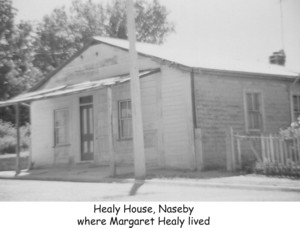
By 1918 Margaret had moved to a Naseby property (possibly the one which is now a Historic Place, pictured left) where she lived until her death brought on by acute alcoholism/heart failure.
In 1921, there is a note in the Otago Daily Times under Accidents and Fatalities: Margaret Healey, aged 70 years, and residing at 8 Haig Street, Mornington, was admitted to the Dunedin Hospital at 3.30 pm yesterday suffering from slight injuries to the head, sustained by being knocked down by a cart in front of the Commercial Hotel, in High Street. She was removed to Mr R Conn's Chemist Shop, where first aid was rendered prior to her removal to the hospital. [Otago Daily Times, Issue 18314, 3 August 1921, page 5]. 8 Haig Street was the address of John Bentley Sharp, her son.
Records show that Margaret Healy died on 5 April 1926 in Naseby and is buried in Plot 55, Block 24 in Andersons Bay Cemetery, Dunedin, with her husband Thomas.
Thomas had spent 52 years and Margaret 54 years in New Zealand.
Her death was recorded in the "Otago Witness":
Healy - on 5 April 1926, Naseby, wife of late Thomas Healy, Lower Kyeburn, 69 yrs. R.I.P.
Also in another paper:
HEALY, On April 5, at Naseby, Margaret, beloved wife of the late Thomas Healy, of Lower Kyeburn, aged 69 years. Deeply mourned, R.I.P. Private Internment at Dunedin.

The inscription on her headstone reads:
Thomas Healy, Also Pte Denis Healy Killed in France 16 Oct 1917. Also Margaret, Beloved Wife of above, Died at Naseby 5 April 1926, Aged 69 years R.I.P.
Margaret Healy's probate documents show that in her will dated 3 April 1926, she left her estate "to my two daughters Susan Healy and Katie Healy and my son Patrick Parnell Healy" and that her estate was valued at £169, being furniture of £7, and an interest in her husband's estate of £162.
Conclusion
Margaret Gallagher was an Irish girl who lived a hard life. Of her ten children, she had the anguish of having one son killed in the Great War, and four others committed to a mental institution. She is remembered as being a tough woman who loved her family deeply. At her death, she had six daughters and two sons still living.
Headstone photo taken by Desmond Sharp.