Sharp-Healy Family
The Story of the first two Generations
Links:
Generation 1
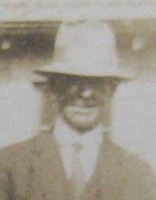
Thomas Healy 1883-1962
Thomas Healy was born on 9 May 1883 at Kyeburn. He was baptised on 16 September 1883; father Thomas Healy; mother Maggie Gallagher; address Kyeburn; minister John Sheehan; godparents: Pat Healy & Ellen Lawless (Lawler in book - Aunt and Uncle); Omakau Book 11 (# Bap 1), pg 34/6. He was enrolled at Kyeburn School on 28 September 1891 (Register No. 105 and 113). The teacher at the time was Miss Alice Annett.
Early Working Years
Thomas worked as a Shepherd and Rabbiter at Longslip Station, Omarama. The men used to do the sheep work during the summer months and in the winter were employed to do the rabbiting. Thomas also brought mail and supplies from Omarama and helped around the farm with general labouring duties. The Rayne Diaries show Thomas was at Longslip between 1907 and 1910, and again at Ben Avon in 1929 and 1931. There wasn't an entry for the year 1930. Ben Avon and Longslip used to be one sheep station before they were split up. You can download and read the Rayne Diaries where the references to Thomas Healy are highlighted in yellow.
Enlisting for the War
When he signed up with the New Zealand Expeditionary Force recruiting for reinforcements for the War in 1917, Thomas was 34 years old. He signed the Attestation of Service and underwent a medical examination to ensure he was fit for duty.
On the form, it states that Thomas was 5 feet 11 inches tall, weighed 168 lbs, had a dark complexion, with grey eyes, and brown hair. His religion was Roman Catholic.
He enlisted on 2 January 1917, and after initial training, embarked on the "MV Ruapehu" (pictured below) on 14 March for England. During the voyage, Thomas was admitted to the ship's hospital for two weeks with German Measles.
The ship arrived at Devonport in England on 21 May, and the troops immediately went to the Army camp at Sling for more intensive training. He left for France on 21 June and was "marched into camp" at Etaples on 23 June. He was later posted to 10th Company of the 3rd Otago Infantry Brigade on 9 July stationed at Rouen. See the Auckland War Memorial Museum Database record.

From there, Thomas served with the Otago Battalion, part of the New Zealand Division of the II ANZAC Corp in France and Belgium, taking part in the many skirmishes and battles in the fourth year of the war on the Western Front.
Of particular note is the Battalion's involvement in the famous battles around Ypres in Belgium, and the push to Passchendaele, in September and October 1917. During this time Thomas was a machine-gunner.
In a letter home at the end of October, Thomas told his sister Margaret that he had seen his brother Denis being carried away on a stretcher after being wounded on 4th October. This was during the Battle of Broodseinde Ridge, and Thomas also said that several of his friends had been killed (Jack Crutchley and Jim Mulholland), but at that stage he didn't know what had happened to his brother. (See the story of Denis Healy.)
The Battle for Passchendaele
The Otago Regiment's official history records the 10th (North Otago) Company being in position on 12th October, ready for the attack on Passchendaele. This was a disastrous episode in New Zealand's war history, in which the New Zealand Division suffered massive casualties. Over 2,730 men were killed, and there are many stories of great suffering and equally great bravery and courage.
The post-attack report outlines the reasons for the New Zealanders' failure to reach its objectives, including the large tracts of barbed wire, German pill boxes which had not been "properly dealt with by our artillery", enemy snipers, the poor and inadequate artillery barrage, and lack of communications. Most of the troops died from shellfire and from being shot, with a large number also being gassed. Many soldiers simply disappeared completely, and were not accounted for as prisoners of war.
The Regiment's official history makes harrowing reading, with in-depth descriptions of the troop movements, and the conditions they endured on the Western Front during the northern winter of 1917 and early 1918. Thomas's service records do not provide much detail on his whereabouts during this time until a note that he was transferred to the 2nd Battalion, Otago Regiment, 10th Company on the 9th of February 1918.
Then on 4 June 1918, Thomas was recorded as being sick and evacuated to a field hospital suffering from psoriasis and seborrhoea, excruciating skin conditions probably as a result of a mustard gas attack. He was transferred to England on 9th July and admitted to the NZ General Hospital at Hurst on the 10th.

There is a gap in the records until it is noted that Thomas was appointed as a Cook at Sling on 25 January 1919 for a month. This was three months after the war ended, so it is assumed he remained in England for a time. But it was not until 18 April that Thomas finally embarked on the troopship "Tofua" (pictured left) for New Zealand from Tilbury Docks. After arriving in New Zealand on 28 May, it took another month before Thomas was finally discharged from the Army on 26 June 1919. (Reported in the Otago Daily Times, Issue 17627, 17 May 1919, Page 7)
By this time, Thomas had served overseas a total of two years 77 days, and received the British War Medal and the Victory Medal (see photos below: Left - Obverse View, Right - Reverse View).
 |
 |
Beverley reports in her memoirs that Thomas was the only member of the family to remain in the Kyeburn area throughout his life. When he returned from the Great War, he went to work on a sheep station in Tarras. He had little use for money, and about twice a year would travel to the "big smoke" (Dunedin) to stay with his sister Rose for one big happy bash of drinking and enjoying himself with Rose's husband Willy. When he wore out his welcome with Rose, he would return to Tarras and not be seen or heard of for another six months.
According to the family, he apparently suffered on-going effects from being exposed to mustard gas which severely affected his health over the years. The beauty and serenity of the Central Otago highlands were a stark contrast to the mud and filth, noise and deprivations of the Western Front in Belgium in late 1917. The clean air of Central Otago would have helped alleviate the symptoms of the mustard gas on his respiratory system.
Death
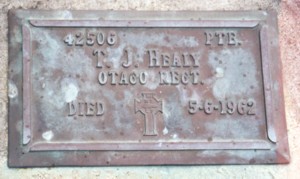
Thomas died on 5 June 1962 aged 81 years. At the time he was a resident at the Montecillo Home in Dunedin. He is buried in the War Graves section of Andersons Bay Cemetery, Block 29S, Plot 2. In his Will he left his four sisters a small sum of money, and his two nephews John Braithwaite and Raymond Johnson the remainder of his meagre estate. It is not known what happened to his war medals.
His death notice in the newspaper read:
Healy, on June 5, 1962, at Montecillo Veterans Home, Dunedin, Thomas Healy, (42506, 1st NZEF) formerly of Tarras, beloved elder son of the late Thomas John and Margaret Healy, of Kyeburn; in his eighty-second year. R.I.P. The funeral will leave our chapel, 78 St Andrew St, on Thursday, June 7 at 10 am for the Andersons Bay Cemetery. No flowers by request. Hope and Sons, Ltd, Funeral Directors.
References
Story compiled from the following sources (slightly edited):
- Army Service History NZ Archives.
- Probate, Estate of Thomas John Healy: Archives New Zealand, DAAC/D239/9076/687-606/62.
- Lieut A E Byrne MC, Otago Regiment NZEF. "Official History of the Otago Regiment, NZEF, in the Great War 1914-1918", 2nd edition.
- Lyn Macdonald. "They Called it Passchendaele. The story of the Third Battle of Ypres and of the men who fought in it". Michael Joseph Limited, London, 1978.
- Chris McCarthy. "The Third Ypres. Passchendaele, the Day by Day Account". Arms & Armour Press, London, 1995.
- John Laffin. "The Western Front Illustrated, 1914-1918". Kangaroo Press Pty Ltd, 1991.
- Brendan O'Carroll. "Khaki angels : Kiwi stretcher-bearers in the first and second world wars". Wellington, N.Z. : Ngaio Press, c2009.
- William Rayne Diaries, provided by Pat McCormack, edited and uploaded as pdf by Dale Hartle.
Online database references:
- Cenotaph Project, Auckland Museum
- Cenotaph Project, Auckland Museum - Embarkation record, 14 March 1917
Download and print a summary of the History of the Otago Regiment, and the Battle of Broodseinde Ridge (9 page pdf).
Headstone photo taken by Margaret Bremner of Dunedin.
Dale Hartle visits Thomas Healy grave at Andersons Bay, Dunedin, December 2019
